
In a quiet place near the Sea of Galilee, a great crowd gathered to hear Jesus teach. They had followed Him for healing, for hope, and for truth. As the day grew late, hunger set in. Thousands of people — men, women, and children — had nothing to eat.
The disciples saw the problem clearly.
“No food.”
“No money.”
“No nearby town.”
From a human perspective, the situation was impossible.
Then Jesus asked a simple question: “Where shall we buy bread for these people to eat?” It was not a question of logistics — it was a test of faith.
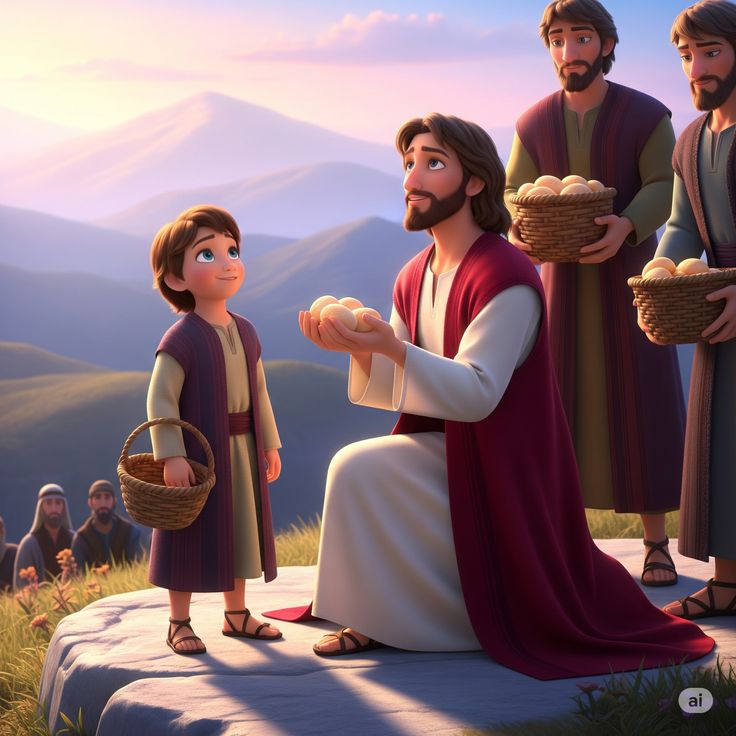
Among the crowd was a young boy carrying five barley loaves and two fish. It was a small meal — barely enough for one person, let alone thousands. Yet the boy offered what he had. He did not wait to have more. He simply gave.
Jesus took the loaves. He gave thanks. He began to distribute.
What happened next defied logic. The bread multiplied. The fish increased. The crowd ate — not just a taste, but until they were satisfied. When the disciples gathered the leftovers, they filled twelve baskets.
What began as scarcity ended in abundance.
This miracle teaches us powerful truths:
-
God does not require abundance to perform a miracle — He asks for availability.
-
What seems small in our hands becomes sufficient in His.
-
Faith is shown not in how much we give, but in whether we trust Him with it.
-
God’s provision is not barely enough — it overflows.
The boy could have kept his lunch. The disciples could have dismissed the crowd. But faith turned limitation into multiplication.
We often look at our resources — our time, our talents, our finances — and say, “It’s not enough.” Yet in the hands of Jesus, little becomes much.
The feeding of the 5,000 reminds us that when we surrender what we have, God releases what we need.